A replay clip is compelling. It is also easy to overtrust.
One user rage-clicks a disabled button. Another exits after a validation error. A third circles the same empty state twice and disappears. The recording makes the pain obvious, but it does not tell the team whether to redesign the flow, fix a bug, change copy, or run an experiment.
Short answer: session replay findings become useful experiment candidates when each clip is converted into a behavior signal, affected cohort, product hypothesis, allowed response, success metric, and rollback rule.
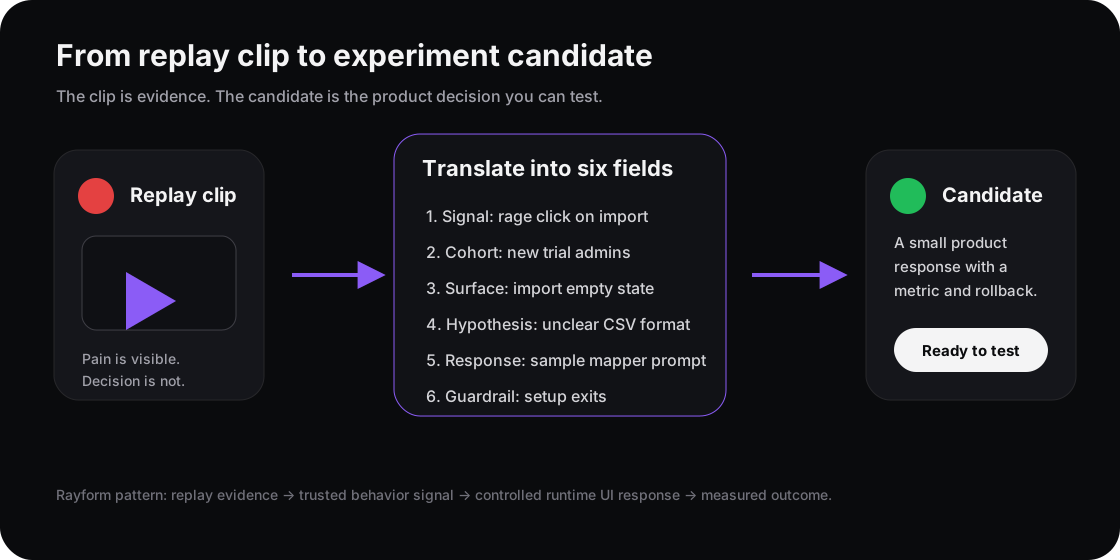
The recording explains the moment. The experiment candidate defines what the product should try next.
A replay finding is not a hypothesis yet
Hotjar’s recording filters can surface rage clicks, u-turns, JavaScript errors, drop-offs, and sessions around A/B tests or experiments. FullStory groups rage clicks, error clicks, dead clicks, and cursor thrashing as frustration signals. Statsig shows why replay becomes stronger when tied to feature flags, because teams can compare sessions that did or did not receive a variant.
That evidence is useful. It still needs translation.
“Users rage-clicked the import button” is a finding. A hypothesis sounds different:
“Trial admins who map three fields and then rage-click the disabled import button do not understand the required CSV format. If we show a sample mapper before the next attempt, completed imports should rise without increasing setup exits.”
Now the team has something it can test.
Use a six-field experiment candidate
Before sending a replay to Jira, fill this out:
| Field | Question |
|---|---|
| Signal | What repeatable behavior appeared in replay? |
| Cohort | Which users or accounts does it affect? |
| Surface | Where should the product respond? |
| Hypothesis | What do we believe is causing the friction? |
| Response | What small change are we allowed to try? |
| Guardrail | What would make us stop or roll back? |
The point is not ceremony. It is to stop treating every painful clip as a redesign request.
A dead click on an empty-state card might become a copy test. A pricing-page u-turn might become a trust-message experiment. An error click after setup might become a fallback-action test. Same replay category, different experiment candidate.
Separate bug fixes from product tests
Some replay findings should not become experiments. If checkout is broken, permissions are leaking, or data can be lost, fix the issue. Do not run a clever test around it.
The experiment path is for ambiguous product friction: confusing empty states, unclear next steps, mismatched expectations, poorly timed prompts, or value messages that do not land for one cohort.
This is where replay triage and error-state response rules connect to experiment velocity. The replay gives the human evidence. The rule decides whether the next move is a bug fix, a product response, or a formal experiment.
Make the candidate small enough to ship
Bad candidate:
“Improve onboarding because several recordings look confusing.”
Better candidate:
“For trial admins under seven days old who exit after opening the import tooltip twice, replace the generic empty state with a sample import path. Measure completed imports in 24 hours. Roll back if dashboard exits rise.”
That can be built, flagged, measured, or routed as a controlled runtime response. It also leaves room for the result to be boring. Maybe the sample path helps. Maybe it does not. Either way, the team learns faster than it would from another watch party.
Eppo’s writing on experiment velocity makes this operational point: running more tests is not enough if teams cannot plan healthy experiments and act on results quickly. Replay can feed that planning step, but only when the finding becomes a crisp candidate.
Where Rayform fits
Rayform sits after the replay finding is structured. Your replay and analytics tools can keep collecting clips, events, cohorts, and flag exposure data. Rayform turns approved behavior signals into runtime UI responses the team can control and measure.
The job is not to make every recording trigger a prompt. The job is to turn repeatable friction into one safe product response, learn from it, and remove it if the guardrail moves the wrong way.
Do this this week: pick one painful replay and do not open a second clip until you can write the six fields. If the fields are missing, you do not have an experiment candidate yet. You have evidence.
See how Rayform turns behavioral signals into runtime UI changes.