Monday morning. Your analytics review produces five decent hypotheses. One onboarding step needs a clearer empty state. A pricing prompt fires too early. A setup checklist keeps sending the wrong users to the same task.
By Friday, none of those changes are live. Not because the ideas were bad. They are sitting in the experiment backlog.
Short answer: experiment velocity improves when small, reversible product responses can move from behavior signal to live UI without waiting for every formal experiment queue.
That backlog is the quiet enemy of product experimentation. Teams talk about test duration, sample size, and statistical confidence. Those matter. But for most SaaS teams, the delay starts earlier: deciding what to test, getting design help, finding engineering time, wiring the flag, checking instrumentation, and agreeing on when the result is good enough to act.
Atlassian’s 2026 State of Product report says only 60% of teams make experimentation a regular part of their process. The rest do little or none. That tracks with the lived version: product teams have signal, but the path from signal to changed experience is too heavy.
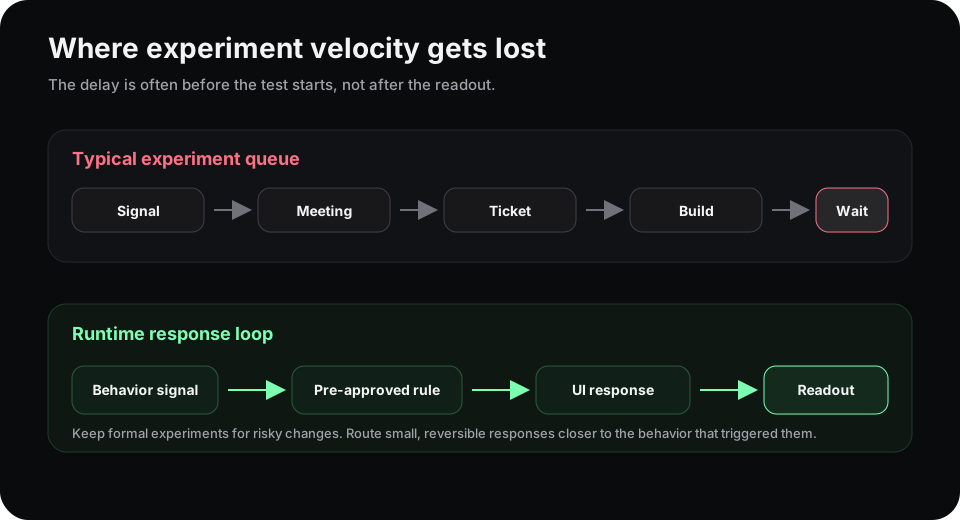
The slow part is often the queue before launch. Runtime response rules move small, reversible changes closer to the user behavior that triggered them.
The five queues inside one experiment
An experiment backlog is rarely one queue. It is five queues stacked together.
First is the hypothesis queue. Someone has to turn “activation is down” into a specific idea: trial admins stall on import step two after seeing a permissions error.
Second is the design queue. Even a small copy or layout change needs an approved version. If the surface is sensitive, that becomes a mini design review.
Third is the engineering queue. A variant has to be built, flagged, targeted, and released. Tools like LaunchDarkly reduce the release pain, but they do not remove the need to create the alternate experience.
Fourth is the instrumentation queue. The team has to trust that Amplitude, PostHog, Segment, or the warehouse will capture the right outcome. Eppo’s writing on experiment velocity puts real weight on diagnostics, planning, and exit criteria for this reason. A broken test is worse than no test.
Fifth is the decision queue. Statsig points to techniques like rollout measurement, parameters, CUPED, and holdouts because mature teams need faster ways to read results. Optimizely makes a related warning: higher test volume still fails if the metrics do not connect to business outcomes.
That is a lot of machinery for a small in-product response.
Not every response deserves a full test
Some changes should go through the formal experiment path. Pricing pages, checkout flows, package limits, and anything with legal or brand risk deserve careful controls.
But many product responses are smaller and reversible:
| Signal | Heavy path | Lighter path |
|---|---|---|
| User repeats the same setup error | Design a new onboarding experiment | Show a contextual example for that error state |
| Trial admin opens pricing after inviting teammates | Queue upgrade modal variants | Explain the relevant plan inside the current workflow |
| New user skips the same checklist item twice | Rebuild the checklist | Hide that item and route to the first value action |
The lighter path still needs rules. It is not random personalization. The team should pre-approve the trigger, the allowed response, the guardrail metric, and the rollback condition. The difference is that the response does not wait for a new sprint every time the same behavior appears.
Measure experiment velocity before the test starts
If you want the useful number, track time from signal to live response.
Use this split:
- signal found
- hypothesis approved
- response approved
- response live
- readout complete
Most teams only measure the last piece. That hides the real drag. If a two-week experiment took three weeks to start, your experiment velocity problem is not statistics. It is queue design.
This is why A/B testing feels too slow and why teams can have strong dashboards but still run few regular experiments. The product knows something useful before the organization can act on it.
Where Rayform fits
Rayform’s angle is simple: the telemetry should not stop at a dashboard.
If a user pattern is clear enough to define, it is often clear enough to route. A product team can set a controlled rule from existing behavioral telemetry to a small UI response, then watch the outcome. That does not replace formal experimentation. It reserves the formal path for changes that need it.
Do this this week: pick one backlog item that has been waiting for more than seven days. If the response is small, reversible, and tied to a clear behavior signal, write the trigger, response, guardrail, and rollback rule on one page. If that feels safer than waiting another sprint, the backlog was the bottleneck.