A bandit test can move traffic toward a better variant while the experiment is still running. That is useful. It is also easy to overrate.
The algorithm answers one narrow question: which variant should get more traffic right now? It does not answer the product question that comes next: who should see the winner, on which surface, under what guardrail, and when should the rule stop?
That missing layer is where adaptive experiments get messy.
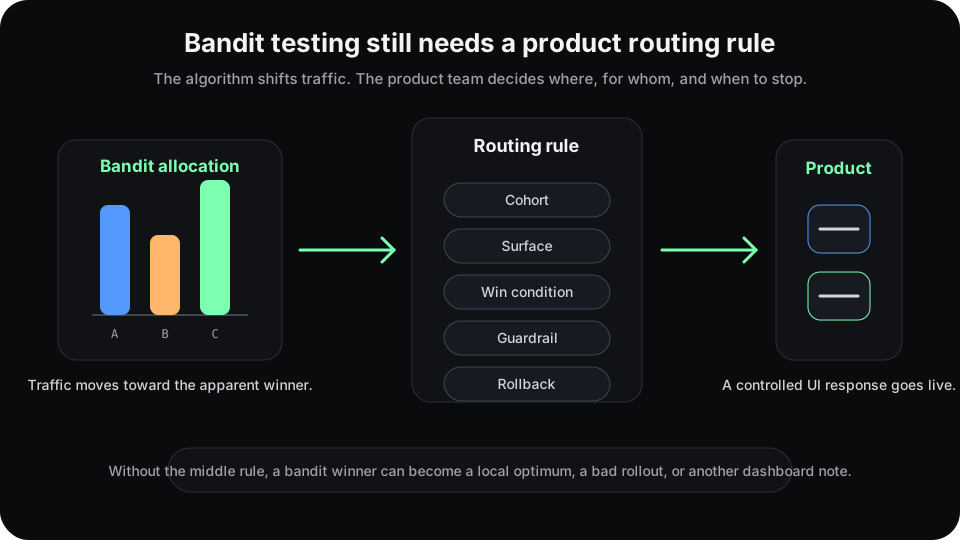
The algorithm shifts traffic. The product team still has to write the operating rule.
What bandit testing actually changes
Multi armed bandit testing changes allocation. Instead of holding variants at a fixed split until the end of an A/B test, the system keeps exploring while sending more traffic to the variant that appears to be winning.
Amplitude’s docs describe bandit experiments as Thompson sampling systems that optimize toward a primary success metric. Optimizely makes the tradeoff plain: multi armed bandits maximize traffic to winning variations, but they do not produce the same statistical significance output as an A/B test. Statsig describes the same basic behavior in Autotune, where traffic allocation follows each variant’s probability of being best.
That makes bandits useful for reversible, high-traffic optimization. Copy, ordering, recommendations, onboarding prompts, and low-risk layout choices can all fit.
But allocation is not product strategy.
The winner may not be global
A bandit can pick a winner that is good on average and wrong for a segment. Statsig calls out this limitation directly: a base multi armed bandit does not account for user attributes or variant interactions the way a contextual bandit would.
That matters in SaaS. A prompt that works for trial admins may be distracting for invited teammates. A pricing message that lifts clicks from power users may increase exits for new workspaces. A setup shortcut may help small accounts and confuse enterprise admins.
So the output cannot just be “variant C won.” The usable output is a routing rule.
Write the routing rule before rollout
Use this shape:
| Rule field | Example |
|---|---|
| Cohort | Trial admins with two active teammates invited |
| Surface | Project home empty state |
| Winner | Variant C invite prompt after 500 exposed workspaces |
| Success metric | Teammate activation within seven days |
| Guardrail | No increase in setup exits or support tickets |
| Rollback | Return to default if exits rise 10% for two days |
That sentence is not fancy. Good. It keeps the bandit from becoming a magic box.
LaunchDarkly’s setup flow hints at why this discipline matters. A bandit still needs a flag or AI Config, a metric, an audience, a targeting rule, and an iteration. Those are product decisions wrapped in experiment tooling. If the team does not write them clearly, the tool will still run, but nobody will know whether the product should keep the result.
Bandits need guardrails, not vibes
A bandit optimizes the metric you give it. If the metric is too narrow, the algorithm can do exactly what you asked and still hurt the product.
A signup CTA variant may win clicks and lower qualified activation. An upgrade prompt may lift conversions and raise churn. A faster onboarding route may improve first action and reduce long-term retention because users skipped setup they actually needed.
This is why activation metrics need to predict retention and why experiment velocity starts before launch. The adaptive part is only safe when the metric and guardrail are already trusted.
The older Rayform bandit guide explains when to choose bandits over fixed A/B tests. This is the next step: once the bandit has enough signal, decide whether that signal should become a product rule.
Where Rayform fits
Rayform sits after the signal is trusted. Your analytics and experimentation stack can keep running A/B tests, bandits, flags, and readouts. Rayform uses behavioral telemetry to adapt the UI at runtime inside rules the product team approves.
The point is not to replace experimentation math. It is to stop pretending the math is the whole decision.
Do this before your next bandit: write the rule in one sentence. “For this cohort, on this surface, route this response while this metric improves and this guardrail stays safe.” If that sentence is hard to write, the bandit is not ready to control the product.
See how Rayform turns behavioral signals into runtime UI changes.