Tuesday morning. Support drops a FullStory link in Slack. Sales adds two Hotjar recordings from a stalled trial account. Someone finds the same moment in PostHog: users keep clicking the disabled import button after mapping three fields.
Everybody agrees it looks bad. Then the team watches more recordings.
That is where session replay usually breaks down. The evidence is vivid, but the workflow is fuzzy. Teams collect clips, debate whether the behavior is common enough, file a ticket with a video link, and hope the fix survives sprint planning.
Session replay triage needs a tighter loop. Do not ask, “What did we see?” Ask, “Which users hit which surface, why did it fail, and what should the product show next?”
What session replay is good at
Session replay is strongest when it shows the exact moment a product promise fails.
Hotjar describes recordings as renderings of real visitor actions: clicks, taps, scrolling, and movement across pages. FullStory adds frustration signals like rage clicks, dead clicks, error clicks, and thrashed cursor. PostHog puts recordings next to product analytics, feature flags, and experiments, so teams can move between behavior and cohorts.
That combination is useful. A dashboard may say onboarding completion dropped. A recording shows the user clicking a button that looks ready but is still disabled. The replay gives the human texture the metric cannot.
But replay is not a priority system by itself. Ten painful videos can still describe a small edge case. One boring-looking stall can be expensive if it hits every high-intent trial admin.
The triage ladder
Use a ladder instead of a watch queue.
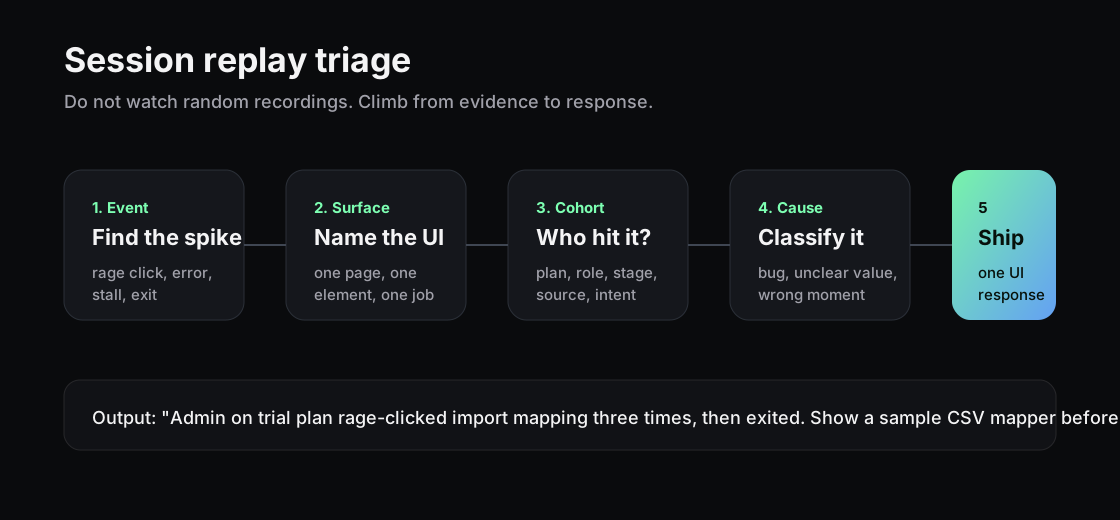
The useful output is not a pile of clips. It is a specific behavioral rule the product can respond to.
Start with the event. Pick one signal: rage click on an element, JavaScript error before a click, repeated backtrack, long idle time, or exit after a form validation error.
Name the surface. “Users are confused in onboarding” is too broad. “Trial admins stall on import mapping step two” is narrow enough to fix.
Attach the cohort. Pull role, plan, workspace age, acquisition source, prior actions, and eligibility from Amplitude, Mixpanel, Segment, or PostHog. A first-session founder and a returning enterprise admin may need different responses.
Classify the likely cause. Is the UI broken? Is the affordance misleading? Did the user hit the feature before they had the data or permission needed to use it? Did the copy explain the task but not the value?
Then choose one response. Not a redesign. One product response for that cohort on that surface.
A replay is evidence, not the fix
Suppose five recordings show trial admins rage-clicking an import button. The bad triage version is a Jira ticket that says, “Users are struggling with CSV import,” with three replay links attached.
The better version is this:
“Trial admins in workspaces under seven days old map three fields, hit a disabled import button, open the help tooltip twice, and exit. Show a sample CSV mapper before the next import attempt. Measure completed imports within 24 hours.”
That sentence has a surface, a cohort, a behavior, a response, and an outcome. It can become a product rule. The replay still matters, but it is no longer carrying the whole decision.
What to instrument before watching more video
Before the next replay review, make sure the surrounding events exist:
- Surface viewed
- Key element clicked
- Error or validation state shown
- Help, tooltip, or docs opened
- Backtrack, retry, or exit
- Success event after the response
This keeps the team from treating recordings like anecdotes. You can still watch the clip, but now you know whether it represents five users or five hundred.
Where Rayform fits
Rayform is built for the step after triage. It reads behavioral telemetry from stacks like PostHog, Segment, Amplitude, and Mixpanel, then adapts the UI at runtime for the cohort showing the pattern.
A replay might reveal that trial admins stall on CSV import. Rayform turns that signal into a response: show a sample mapper, change the empty state, delay the advanced prompt, or route the user to a smaller first action. The dashboard measures whether the response worked.
The goal is not to watch fewer recordings because recordings are bad. The goal is to stop leaving the fix trapped inside the recording.
Try this this week
Pick one painful replay from the last seven days. Write the triage sentence before opening another clip:
“When users in cohort X do behavior Y on surface Z, show response A and measure outcome B.”
If you cannot fill in the sentence, you do not need more recordings yet. You need the missing event, cohort, or response owner.
See how Rayform turns behavioral signals into runtime UI changes.