Your onboarding checklist has a completion rate. That number is useful, but it is not the goal.
A checklist can tell you who invited a teammate, connected a data source, and clicked through the tour. It cannot tell you whether those users reached the first moment where the product became worth returning to. Worse, it can make a team optimize for finishing setup instead of shortening the path to value.
That is the onboarding checklist trap: the product asks every user to complete the same ritual, then treats completion as activation.
Completion is not activation
Completion means the user finished the tasks you put in front of them. Activation means the user did the smallest action that proves they understand the product’s value.
Those two events can overlap. They often do not.
A high-intent founder might skip every tour step, connect Stripe, and create the first live report in six minutes. A low-intent evaluator might complete the entire checklist and never come back. If the dashboard only rewards completion, the second user looks healthier than the first.
Amplitude’s onboarding measurement guide frames onboarding around engagement, conversion, and meaningful user actions. Appcues tracks completion rate, time to value, activation rate, drop-off by step, and feature adoption. That mix matters. Completion is one signal in the set, not the scoreboard.
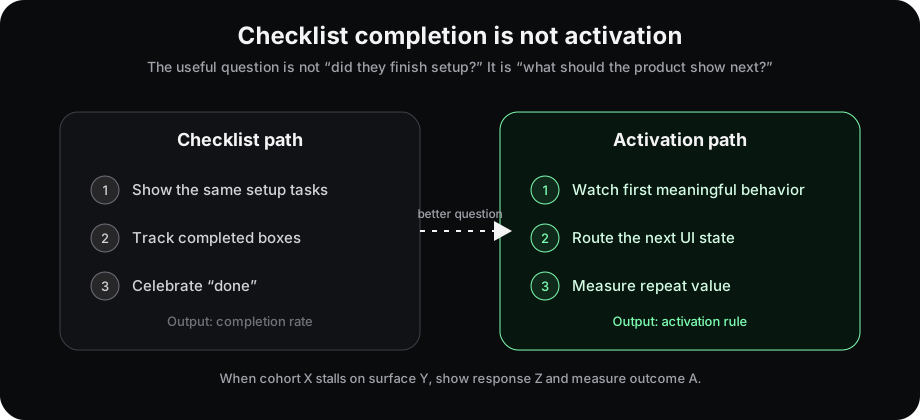
The better output is not a finished checklist. It is a rule for what the product should show next.
The behavior that matters after signup
Start with one activation event. Not ten. One.
For a product analytics tool, it might be creating the first chart from real data. For a collaboration tool, it might be the first shared workspace comment. For a devtool, it might be the first successful API call.
Then track the behavior around that moment:
- Which role or account type reached it?
- Which setup step came right before it?
- Where did users backtrack, idle, rage click, or exit?
- Did they repeat the value action within 7 or 14 days?
This turns onboarding from a checklist into a routing problem. The product should respond differently to a user who skips setup and reaches value fast, a user who gets stuck on permissions, and a user who completes steps without touching the core workflow.
PostHog’s activation writing makes the same practical point: activation is high leverage precisely because each product has to define it for itself. You do not find activation by copying another company’s checklist. You find it by watching which early behavior predicts return usage in your own product.
If you need to find the stall point first, start with funnel drop-off analysis. If the flow needs to change by user type, the same logic shows up in adaptive onboarding.
Replace checklist logic with response logic
A checklist asks, “What has the user finished?”
Response logic asks, “What does this user need next?”
If a workspace admin connects data but stalls before inviting a teammate, show a sample collaboration workflow, not another generic setup badge. If a solo founder reaches the core feature without help, get out of the way. If a trial user keeps opening the docs from the same empty state, change the empty state for that cohort.
This is where product analytics usually hands off too early. Amplitude, Mixpanel, PostHog, and Segment can describe the cohort and the behavior. The hard part is making the interface react before the next sprint.
Rayform is built for that last mile. It reads behavioral telemetry from the stack a team already has, then adapts the UI at runtime for the cohort showing the pattern. The dashboard still measures whether activation improved. The product stops making every new user walk the same path.
Try this this week
Pick your current onboarding checklist. Keep it open, but stop treating it as the source of truth.
Write one sentence instead:
“When new users in cohort X do behavior Y on surface Z, show response A and measure activation event B.”
If you cannot fill in the sentence, the next step is not a better checklist. It is better activation instrumentation.
See how Rayform turns behavioral signals into runtime UI changes.