An account adds six teammates, exports reports every day, hits the workspace limit twice, and opens the admin page after each block.
Sales gets a “maybe expansion” task. The product keeps showing the same limit message.
That is a weak handoff.
Short answer: expansion revenue is easier to capture when product usage changes the product path first. A good expansion rule names the account signal, surface, allowed response, guardrail, and owner before anyone sends a deck.
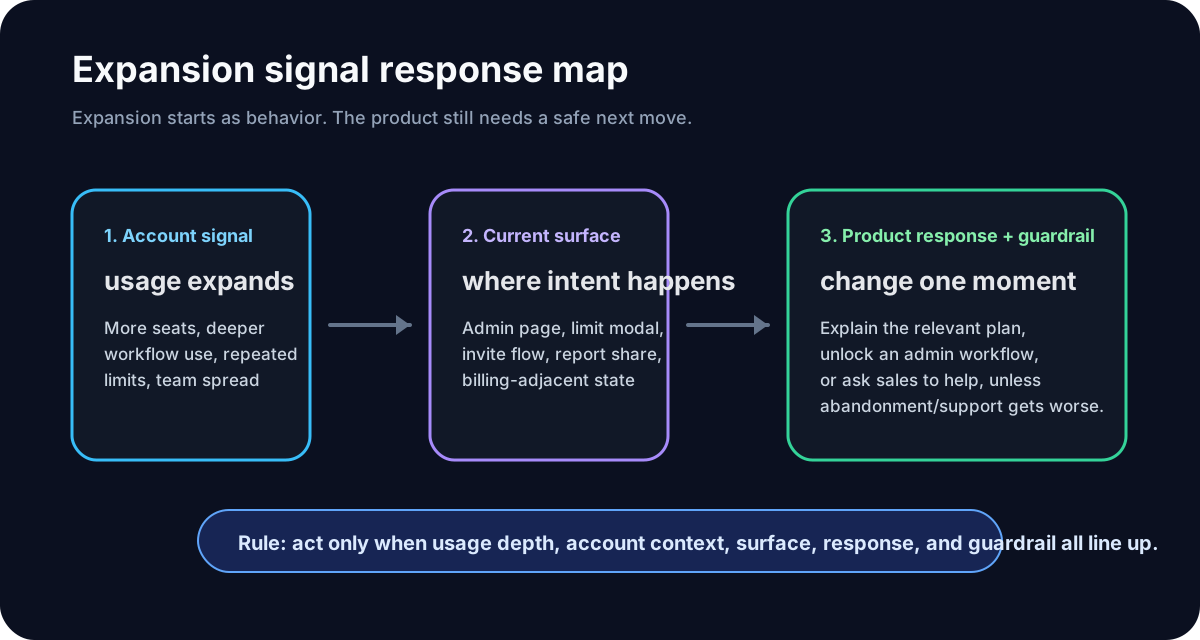
Expansion starts as behavior. The product still needs a safe next move.
Expansion signal is not just more usage
Appcues’ guide to product-led growth metrics frames PLG metrics as behavioral signals tied to revenue outcomes like conversion, retention, and expansion. That is the useful part. Expansion is not a vague feeling that an account is “healthy.” It is a pattern that says the account may need a bigger plan, another workflow, more seats, or a human conversation.
But more usage can mean different things:
- real team adoption
- a single power user doing extra work
- a blocked admin trying the same action again
- a team bumping into a packaging limit too early
- a customer using the product heavily but not getting more value
Those should not all trigger the same upsell prompt.
Map the signal to a surface
Pendo’s article on product-led retention and expansion points to individual- and account-level analytics as inputs for customer health, churn risk, and grow-likelihood signals. The account level matters because expansion is rarely one click from one user.
A useful expansion row looks like this:
| Field | Example |
|---|---|
| Account signal | Three teammates use shared reports weekly |
| Current surface | Report sharing and admin invite page |
| Product response | Show the team plan benefit inside the share flow |
| Guardrail | No rise in share-flow abandonment or support tickets |
| Owner | Growth PM owns the response; sales owns follow-up if usage continues |
Now the team has a route, not a revenue wish.
Let the product respond before the pitch
Salesforce’s PLG guide makes a practical point: product usage paired with customer context can guide expansion timing. That does not mean every signal should become a modal. It means the product should do the smallest helpful thing at the moment the need appears.
For example:
| Expansion shape | Better first response |
|---|---|
| More teammates invited, no admin setup | Route the admin to team permissions and ownership |
| Repeated limit hits after real value | Explain the relevant plan at the blocked action |
| Multiple departments using one workspace | Show workspace structure or sales-assist with usage context |
| Heavy usage but weak outcome | Do not upsell yet; show the path to value first |
The last row matters. Expansion prompts get annoying when they confuse activity with value.
Expansion is account behavior, not a sales-only score
OpenView’s early product-led growth definition included product usage as a driver of acquisition, retention, and expansion. Its Expensify example is still a good pattern: multiple users from the same company sending expenses through one person was treated as a signal that the account had a broader need.
That is different from a generic PQL score. A score says, “this account is worth attention.” A product response says, “when this account hits this limit on this surface, show this explanation, then alert sales only if the account keeps expanding.”
The second version is narrower. Good.
Where Rayform fits
Your analytics stack can detect usage depth, team spread, feature adoption, limits, and admin behavior. Your CRM can route sales-assist. Rayform’s angle is the step between them: turn an approved expansion signal into a runtime product response with a guardrail.
Expansion revenue should not depend on the product staying silent until sales notices a dashboard. When account behavior shows a real next need, the interface should be allowed to help, measure the result, and hand off with context if a human should step in.
Related reading: pricing-page visits are product signals, PQLs should trigger product changes, and churn risk scores should change the product.