A trial user has two days left. They have opened the dashboard four times, failed connector setup twice, invited nobody, and never reached the value event.
Then the product sends a reminder: “Your trial ends soon.”
That is technically true. It is also not very helpful.
Short answer: free trial conversion is usually a product-response problem before it is a reminder problem. The useful question is not “how many emails should we send before the trial ends?” It is “what should the product do when a trial user shows a specific activation pattern?”
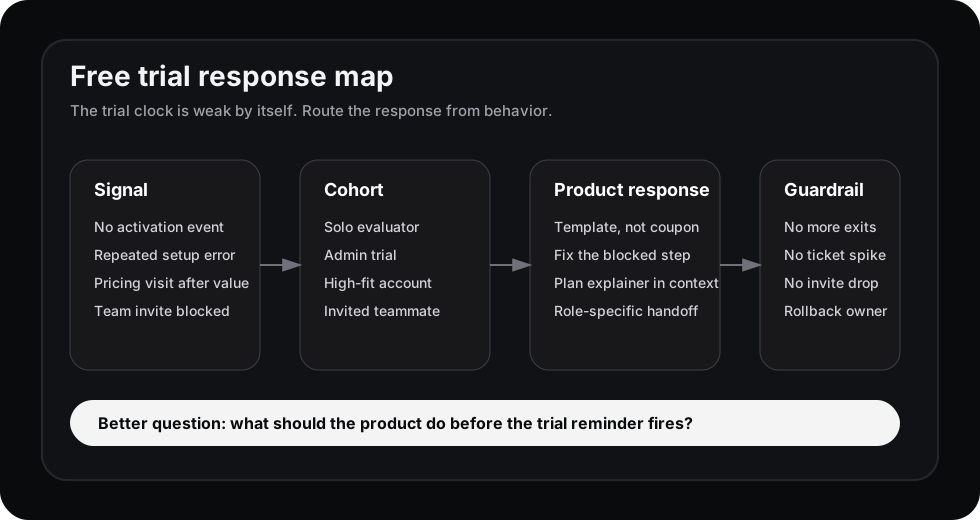
The trial clock matters less than the behavior happening inside the trial.
Trial conversion starts before the paywall
Amplitude’s guide to increasing free trial conversion says trial performance depends on the business model, product experience, packaging, and PLG strategy. It also calls out a simple failure mode: users do not reach the aha moment fast enough or do not see enough ROI during the trial.
That means the conversion problem often starts days before the upgrade screen.
A user who never connected the data source, created the report, invited the teammate, or repeated the core workflow is not weighing a pricing page. They are still trying to decide whether the product works.
Stop treating every expiring trial the same
A countdown email only sees time left. The product can see behavior.
A useful trial-response row looks like this:
| Trial signal | Better product response |
|---|---|
| No activation event after two sessions | Show the shortest path to one value moment |
| Repeated setup error | Replace the generic checklist with help for that step |
| Pricing visit after real usage | Explain the relevant plan inside the current workflow |
| Team invite created but not accepted | Show an invite-status handoff and next action |
| High usage, no upgrade intent | Suppress the nag and wait for a stronger signal |
The last row is important. More prompts are not always better. Sometimes the best product response is to leave a good evaluator alone.
Use activation as the leading signal
Amplitude’s free trial metrics guide defines activation rate as the share of users who reach the aha moment. It also warns that revenue is a lagging indicator. Appcues makes the operating point in its free-to-paid conversion guide: many conversion problems are activation problems with a delayed consequence.
That is the right frame.
A trial user who reaches value and then visits pricing is in a different state from a user who visits pricing because they are blocked. The first person may need plan clarity. The second person may need the product to fix the path before asking for money.
Write the response before writing the reminder
Before adding another lifecycle email, write one sentence:
When a trial user in this cohort shows this behavior on this surface, we will show this product response, unless this guardrail gets worse.
Example:
When a first-workspace admin fails connector setup twice before reaching the first report, show one recommended connector with a shorter setup path on the connector page, unless setup exits or support tickets rise.
That sentence is small because the product change should be small. It names the cohort, behavior, surface, response, and guardrail. It also gives the team a rollback path if the response creates new friction.
Where Rayform fits
Product analytics tools can tell you which trial users activated, stalled, explored pricing, or hit friction. Onboarding tools can show guidance. CRM and email tools can follow up.
Rayform’s angle is the missing middle: turn trial behavior into approved runtime UI responses. The product should react differently to a stuck admin, a high-intent evaluator, and a casual explorer. Not with a giant personalization program. With one narrow rule tied to a surface and a guardrail.
Free trial conversion does not improve because the clock got louder. It improves when the next trial user hits the same moment and the product finally does something different.
Related reading: activation metrics should predict retention, time to value is a product signal, and pricing page visits are product signals.